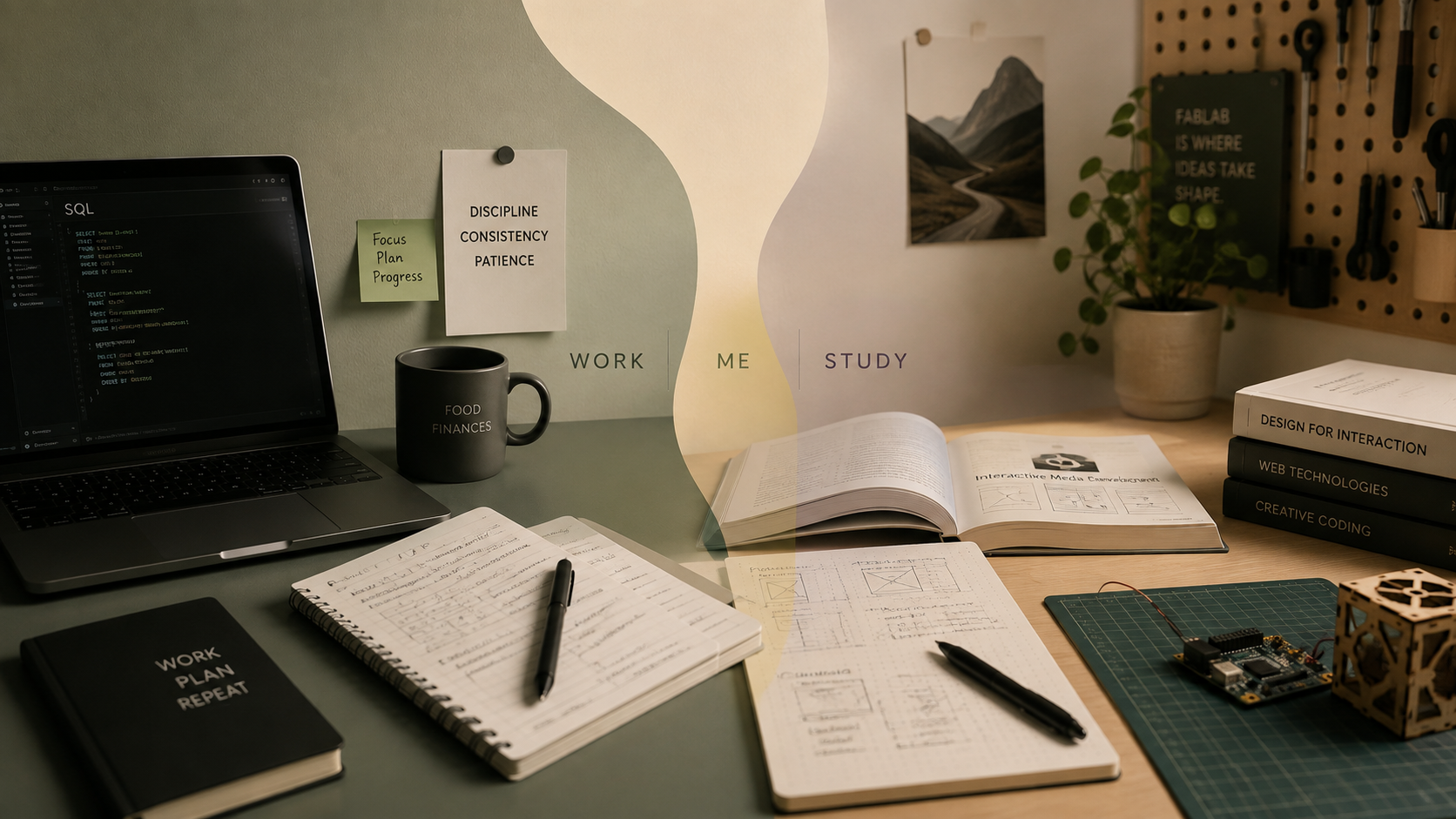
Working full time while studying for a bachelor’s degree was not something I originally expected to be doing. In 2024, I completed my Graduate Degree in Programming at Artevelde University of Applied Sciences. I was happy, proud and convinced that I would quickly find a job and finally start doing what I had been dreaming about for years. Things did not quite go the way I expected, but I will leave that story for another time.
This one is about the job I eventually found, why I decided to start studying again and what combining work and study taught me about planning, pressure and myself.
My first real job
Since the summer of 2025, I have been working at FPS Finance. I started as an Application Tester and later moved into a SQL Developer role, which is even more closely connected to my degree and interests. Working for the government turned out to be much more interesting than I expected. Besides learning about technology, I also started understanding more about how the country works behind the scenes, how taxes are processed and how many systems are involved in things most people barely think about.
It was my first proper full-time job, so almost everything was new to me: colleagues, working from home, meetings, organising my own schedule and, of course, the bad coffee. During the first few months, most of my energy went into figuring out how everything worked. Who was responsible for what? How were the systems connected? Who could help me when something went wrong? At the same time, one thought kept crossing my mind: I still wanted to get my bachelor’s degree.
No one was pushing me to do it. I simply wanted to prove to myself that I could. A bachelor’s degree could open more doors later on, but above all, I wanted to keep learning.
You do not need to have everything perfectly under control to move forward.
How do you combine a full-time job with a bachelor’s degree?
In September, I started the bachelor’s programme in Interactive Media Development at Artevelde University of Applied Sciences. The programme takes one and a half years, but because I work full time, I could not exactly spend every day on campus. My first semester was, to put it mildly, chaotic.
After finishing a full day of work, I often had a second part of the day waiting for me: catching up on lessons, working on assignments, practising and keeping an eye on deadlines. Combining work and study mostly came down to planning ahead. I had to learn which assignments needed several evenings, which deadlines I could prepare for early and when something simply had to be good enough.
At first, I tried to do everything perfectly at once. I wanted to do well at work, do well at school, never miss a deadline, keep seeing my friends and somehow still get enough sleep. That did not last very long. Over time, I became much better at planning. I started recognising which assignments needed more time, when I had to work ahead and when something did not need to be perfect to be good enough.
Making time for Teynur too
Somewhere between work and school, I also had to remember that I still had a life outside both of them. I needed time for myself, my friends and sometimes simply doing nothing. Without that, I do not think I would have been able to keep going for very long.
There were moments when my entire life seemed to fit inside a calendar: work, class, project, meeting, deadline, repeat. Eventually, I realised that taking time off was not the same as wasting time. Having moments where I could switch off was part of what allowed me to stay motivated and continue.
The second semester
The second semester went more smoothly. Not because the workload suddenly became lighter, but because I understood myself and the programme better. I had a much better idea of how much time I needed, where I struggled most and what was expected of me.
I had three resits, which meant that the summer was going to be busier than usual. At the same time, work did not stop either, and the project I was working on at FPS Finance still had to move forward.
So yes, it became another busy period.
Yet I never really experienced studying as something I was forced to do. Even when it was stressful, I still enjoyed building things, solving problems and seeing myself improve. I spent long days working on projects in our school’s prototyping lab, where we could build and test physical and digital projects. A lot of that time was spent fixing things that did not work, trying again and eventually seeing the projects come together.
Work continued. School continued. Slowly, the things I had been building actually started working. At the same time, I realised I was once again leaving too little time for myself.
Not everything has to get full marks
That was when I decided to change the way I approached things. I did not need full marks for every assignment. My goal became much simpler: understand what I was doing, pass my courses and get through the year without constantly putting myself under unnecessary pressure.
That made a significant difference. Once I stopped chasing perfection all the time, I had more room to focus on actually learning.
Today, I have passed everything from my first year. I achieved good results, learned a lot of new things and, more importantly, became much better at combining work, school and the rest of my life. I would not say I have found the perfect balance, because I do not think there really is one.
What I have learned is that you do not need to have everything perfectly under control before you can move forward. Sometimes you adjust your plans. Sometimes you work harder. Sometimes something goes wrong and you try again. And sometimes the best thing you can do is deliberately do absolutely nothing for a while.
That is probably the most useful thing this year has taught me.