When I started working on Het Fossielenspoor, I knew I had to develop an interactive museum installation for Kina, a museum of nature and children in Ghent. I already had experience building websites and digital applications, but this assignment was different. This time, I wasn't just developing software. I also had to think about the physical structure, electronics, materials and, most importantly, how children would interact with the installation.
On paper, it all seemed fairly straightforward. You come up with a concept, develop it and build it. But throughout this project, I realised once again how big the difference is between designing something and actually making it.
And perhaps that was exactly what made it so interesting to me.
From Looking to Discovering
My first step was to explore how children experience a museum. During my visit to Kina, I noticed that children respond differently to an installation when they can actually do something themselves. Looking at an object behind glass is one thing, but turning something, touching it or triggering a reaction creates a completely different experience.
That got me thinking. How could I make fossils more interesting for children without simply placing another information screen next to them?
I wanted children to feel like they were discovering something themselves.
My initial ideas were bigger and technically more complicated. I considered creating a more immersive experience that combined projections with different interactive elements. It sounded interesting, but as I continued researching what was realistic, I started questioning whether all that extra technology was really necessary.
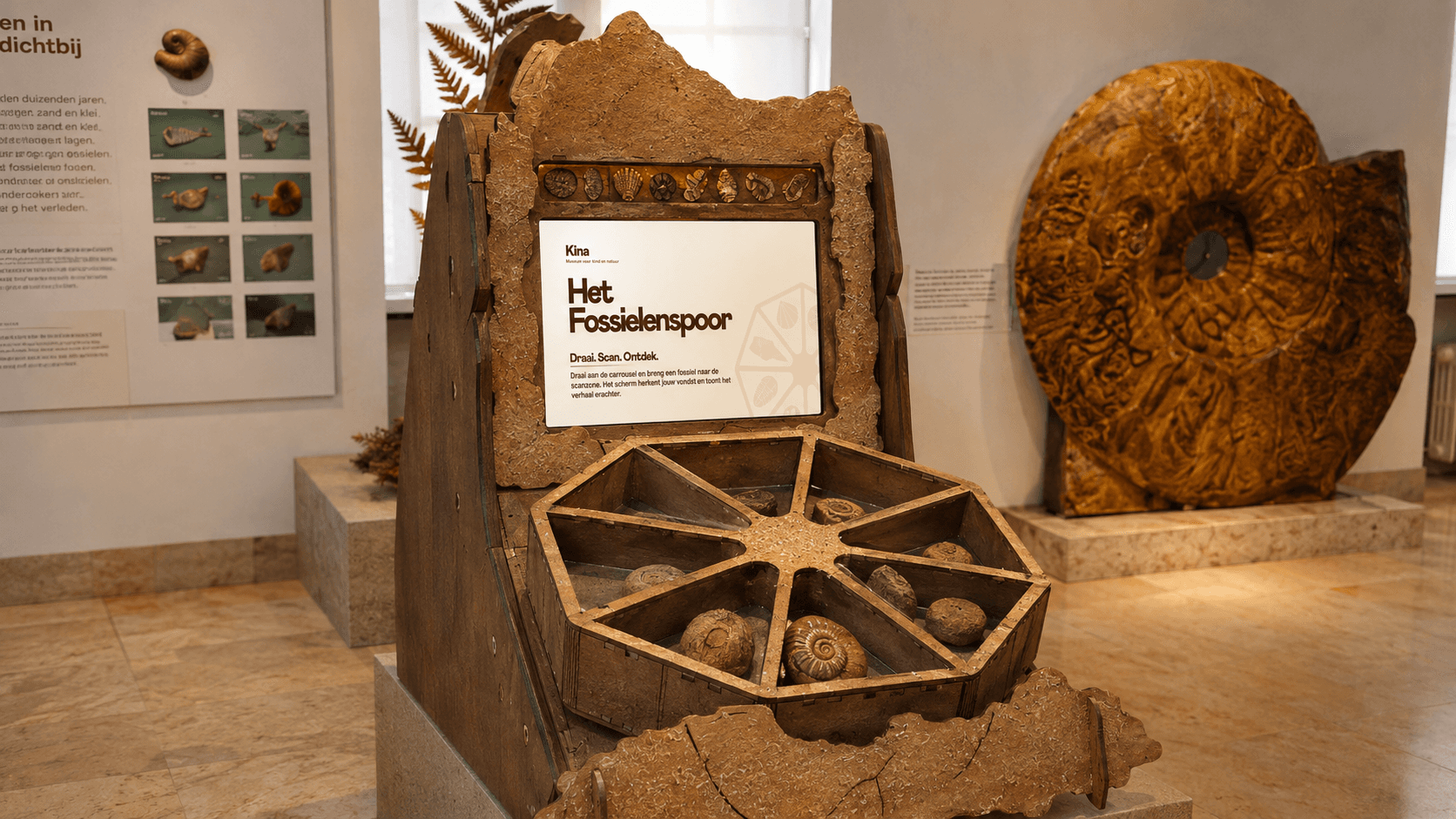
Eventually, I settled on a simpler concept: a rotating carousel with eight fossils.
Children turn the carousel themselves. When a fossil reaches the scanning area, it is automatically recognised. Images and information about the fossil appear on a screen, an audio fragment starts playing and a light indicates which fossil has been discovered.
No complicated menus or buttons. The entire interaction starts with one simple movement.
What I liked about this approach was that the technology didn't need to be visible. A child doesn't need to understand RFID or know how a Raspberry Pi works. They just need to realise they can turn the carousel and discover something.
Building It Was Another Story
Once the concept was clear, the real work began. I had to develop the software, but I also had to physically build the installation.
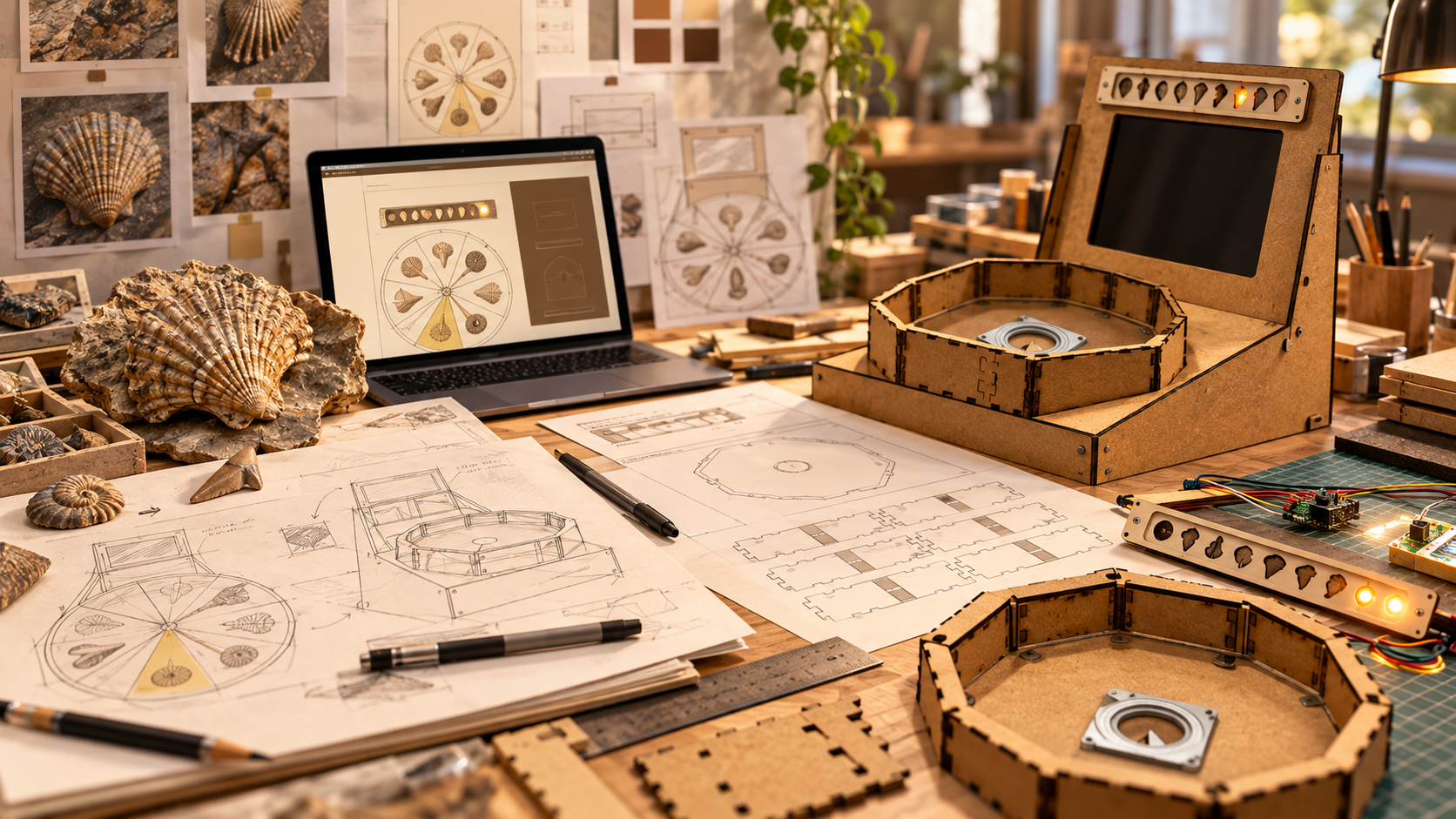
I worked with MDF, plexiglass, a rotating platform, 3D-printed fossils and several electronic components. The enclosure was laser-cut and needed to be strong enough for children to use. At the same time, all the cables and electronics had to be safely hidden away.
The first version looked good on paper, but once I started building it, I realised it wasn't sturdy enough. The back of the installation, where the screen was mounted, caused most of the problems. I had originally designed a structure that could be opened easily for maintenance, but the weight of the screen made it less stable.
So I had to reconsider the design.
That was an interesting moment for me. I could have kept trying to make my original design work, but it was becoming obvious that a different solution would be better. I adjusted and reinforced the structure, and later added extra exterior panels.
The lighting also turned out to be more complicated than expected.
At first, I used a regular LED strip. However, it wasn't ideal for lighting up each fossil individually. In the end, I cut the LEDs apart and soldered them back together so I could position each one exactly where it needed to be.
These are the kinds of things you don't always think about while designing. You draw something, imagine how it should work and assume you've found the solution. Until you actually start building it and realise things don't always work the way you expected.
More Than Just Programming
Besides the physical construction, the software also had to work.
I developed a web application that runs locally on a Raspberry Pi. An RFID reader identifies the fossils, while an ESP32 controls the LED lighting. All these components needed to communicate correctly.
When a fossil is detected, the right information has to appear, the audio has to start and the corresponding light has to respond. It sounds simple, but behind that single action are several systems that need to work together at exactly the right moment.
I also developed an admin panel that allows fossil information, images and settings to be updated without having to modify the code directly.
That mattered to me because I didn't just want the installation to work during a demonstration. I also wanted to think about what would happen afterwards. How would someone update the content? What if an RFID tag needed replacing? How could the electronics be accessed if something stopped working?
Those questions influenced many of my design decisions.
This project also made me realise how closely my different interests are connected. My background in graphic design helped with the visual appearance and finishing. My programming knowledge helped me build the software. And by constructing the installation myself, I had to solve problems I probably wouldn't encounter when developing a regular website.
I really enjoy switching between designing, programming and making things.
Not Everything Needs to Be Complicated
Looking back, that might be the most important lesson I learned.
At the beginning, I had bigger ideas and wanted to combine several technologies. But the concept actually became stronger when I started removing certain things.
For example, the carousel doesn't use a motor. Visitors turn it themselves. That made the installation simpler, more reliable and, in a way, more interesting, because children decide which fossil they want to discover.
Running everything locally was also a deliberate decision. I didn't need a complicated online platform for this installation. What mattered most was that it could work independently and reliably.
Throughout the project, I started to understand that a technically complicated solution doesn't automatically create a better experience.
Sometimes you achieve more by making something simpler.
What I Took Away From It
In the end, I managed to turn Het Fossielenspoor into a working prototype. From the initial research and sketches to the software, electronics, enclosure and finishing, I had the opportunity to work on many different aspects of the project.
Of course, that doesn't mean everything is completely finished. An interesting next step would be to test the installation with children over a longer period in Kina's actual museum environment. That's when you can really observe how visitors interact with it and discover what might still need improving.
But even without that step, this project taught me a lot.
Most importantly, I learned not to become too attached to my first idea. Some problems only become visible when you actually start building something. And sometimes you have to change work you've already spent hours on because you've found a better solution along the way.
I spent a lot of time on things that visitors will barely notice. Hiding cables, reinforcing components, soldering LEDs and making sure everything responds at the right moment.
But all that work is what allows someone else to simply turn a carousel and discover something without needing further instructions.
And I think that's a satisfying result. Not because the technology is as impressive as possible, but because all those different parts come together to create something simple that people can actually use.
Het Fossielenspoor reminded me that I don't just enjoy developing digital applications. I find it just as interesting to take an idea all the way from an initial sketch to something I can actually stand in front of.